AI 5 min read
AI Field Notes: Could the biggest AI opportunity in business underwriting lie in the “maybe”?

For years, much of the friction in business underwriting has come from getting ambiguous cases to the point where reviewers can make a confident credit decision. The manual effort behind these nuanced decisions can cost credit teams efficiency and contribute to customer drop-off. But recent advances in agentic AI are starting to change that.
More of the contextual, hard-to-structure information that traditionally pulled experienced underwriters into the process early can now be reviewed, compared, and investigated before they need to step in.
For lenders, the immediate opportunity is not simply to automate more approvals or declines. It is to reduce the manual investigation required to resolve the “maybe”: the cases where additional context could still change the decision. Solve this, and credit teams can increase their lending volume significantly while keeping risk in check.
Key takeaways
- The biggest near-term AI opportunity may lie in the “maybe”. Agentic AI can investigate ambiguous cases earlier, reducing the manual work needed to get them ready for a confident credit decision.
- That can change the economics of investigation. If ambiguous cases take less time and effort to understand, lenders can assess more of them without changing their credit standards.
- Agentic AI should sit alongside existing underwriting capabilities. Rules can handle deterministic signals, AI agents can investigate what sits behind them, and underwriters can focus on judgment.
- The right threshold for human review should be tested, not assumed. Shadow runs and side-by-side testing can show where AI is reliable and where underwriter expertise still adds meaningful value.
Why the “maybe” is where agentic AI gets interesting
Traditional lending automation has been strongest where the signal and response are already well defined. Over time, data, rules, and automated checks have made it easier for lenders to identify obvious outcomes early and move straightforward cases through the process efficiently.
The harder part is what happens when the signal itself is not enough to reach a conclusion.
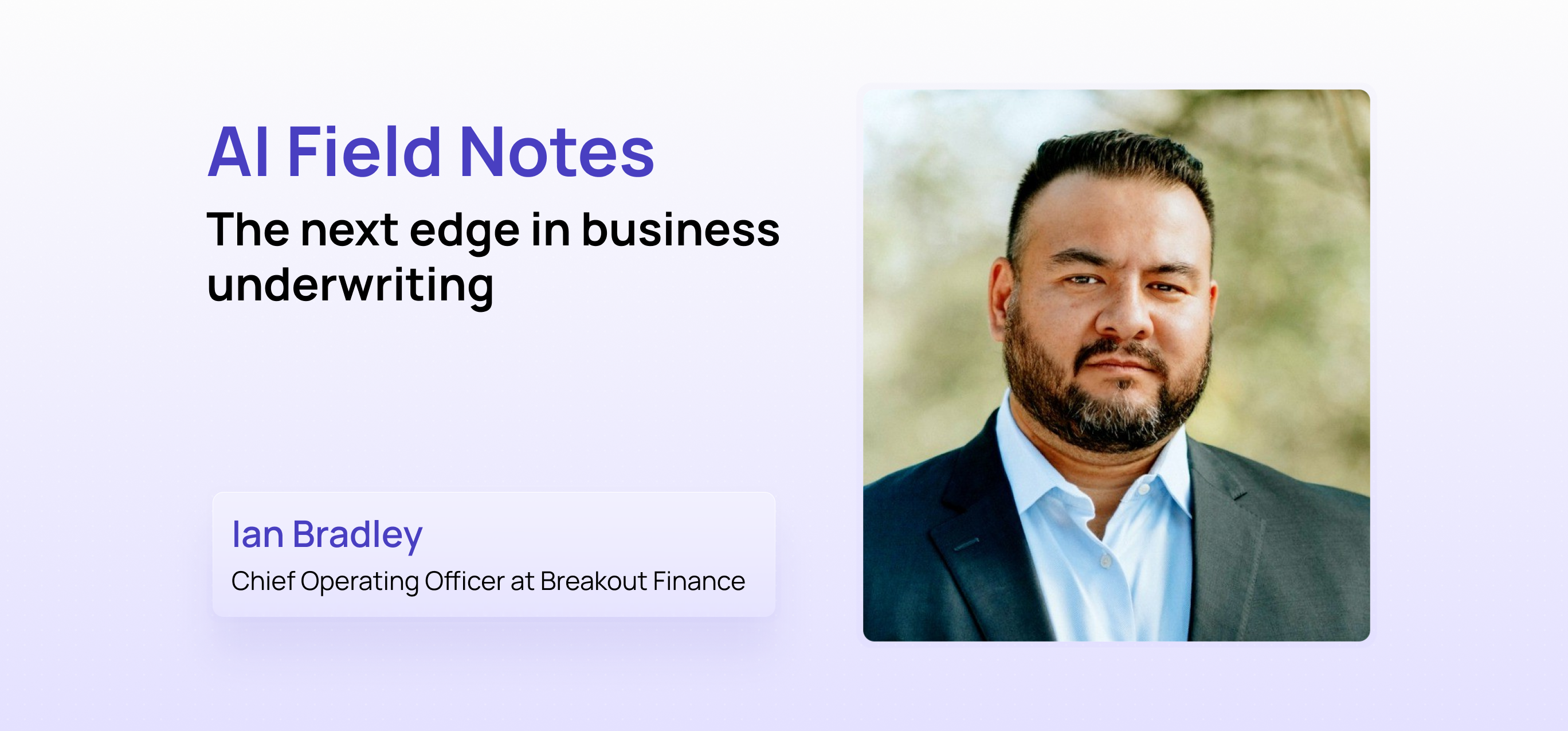
Ian Bradley, Chief Operating Officer at Breakout Finance, described this recently through a simple traffic-light analogy:
“Red and green light cases are generally easier to resolve. The yellow light cases - the ones where the answer isn’t obvious yet - are where more work is required. You need to spend time figuring out what would turn the case a bit more green, or which variables are actually making it more red.”
Take a borrower whose revenue has fallen outside an expected range. The signal may be easy to spot, but the initial conclusion can be premature. The harder work is understanding what sits behind it: whether the change is temporary or structural, whether the borrower’s explanation is supported elsewhere in the file, and what further evidence could materially change the view.
That additional context can move the decision in either direction. A file that initially looks weak may become more compelling after deeper diligence, while an apparently strong application can reveal underlying issues once the evidence is examined more closely.
Historically, much of that investigation has fallen to the underwriter. Agentic AI can now handle more of it earlier by reviewing less structured information, comparing evidence across sources, surfacing inconsistencies, and identifying what remains unresolved.
For teams, the opportunity is to reduce the time underwriters spend assembling the evidence needed to make a confident decision. And once the cost of doing that work falls, the impact goes beyond underwriter efficiency.
Changing the economics of the “maybe”
Some borrowers are expensive to assess because the credit itself is genuinely complex. Others simply take a lot of work to understand.
That distinction matters, particularly in smaller business lending. A borrower may ultimately fit within the lender’s risk appetite, but several hours of manual investigation can still make the case difficult to justify pursuing.
This is where reducing the work around the “maybe” starts to change more than turnaround time. If AI makes it quicker and cheaper to reach a clear view of an ambiguous borrower, deeper investigation can become viable in cases that previously took too much manual effort to justify.
Hear more perspectives on AI transformation in financial services
Applying AI to the “maybe” shouldn’t mean rebuilding underwriting from scratch
Importantly, while AI tools can speed up investigative work, they shouldn't require teams to throw away their existing underwriting processes, rules, or controls. In many cases, these new solutions can be introduced into the existing workflow alongside the systems and capabilities already working well.
In many ways, this builds on a shift lending teams have already been through. Caitlyn Wagner, SVP of Credit at Breakout Finance, noted that automated decision trees have already removed much of the manual work from initial intake and routine data gathering. AI extends that same progression into work that is harder to capture in deterministic logic.
Consider the revenue-decline case Ian shared. Here’s how the process changes once you add AI into the workflow:
- A rule identifies the signal. Revenue has fallen beyond an expected range, triggering further review.
- AI investigates what sits behind it. An agent can compare recent and historical performance, review supporting information, look for likely drivers of the decline, and surface evidence that supports or contradicts the initial explanation.
- Workflow coordinates what is still needed. If something material remains unresolved, the process can request further evidence or route the case through the appropriate review.
- The underwriter applies judgment. Instead of reconstructing the case from the beginning, they can start with a more precise question: given what caused the decline, what has happened since, and the evidence available, does this materially change our view of the risk?
This can also help move the assessment beyond a static view of the borrower. Ian described the difference as moving from a “photo” toward a “movie”: the point-in-time signal still matters, but so does what happened before it, what has happened since, and whether that trajectory changes how the risk should be understood.
The underwriter is still making the credit judgment. What changes is how much investigative work has already happened before the case reaches them.
More broadly, this can be a useful way to think about applying AI to underwriting. Structured data can continue to establish known facts. Rules can handle deterministic policy. AI can work through the parts of a case that are harder to structure or require further investigation. Workflow can coordinate what happens next. Then, human expertise can stay focused on the questions where context, trade-offs, and experience materially affect the answer.
The value comes from using those capabilities together, rather than treating underwriting as a choice between automation and people.
Finding the right threshold for underwriter review in your own “maybe” cases
Where AI should sit in that process will look different for every lender. A useful starting point is not to decide upfront what AI should or should not do, but to understand what is actually happening in your “maybe” cases today.
Breaking referrals down by why they require human involvement makes the opportunity easier to see. Teams can distinguish between cases that need more information, deterministic policy resolution, further investigation, or genuine credit judgment — and identify where experienced underwriting capacity is being used before that expertise is actually required.
From there, the threshold can be tested rather than assumed.
One practical approach is to run AI alongside the existing process on the same cases. Does it identify the same relevant evidence? Does it surface the same inconsistencies? Does it miss anything material? And when the case eventually reaches the underwriter, how much do they materially change or add to what has already been prepared?
Shadow runs and side-by-side testing allow teams to answer those questions before changing the live workflow. They can also expose assumptions about which parts of the underwriting process genuinely require expertise and which have simply become embedded in the way the work has traditionally been done.
Ian described this as challenging the traditional thinking around a lender’s “secret sauce”:
“The secret sauce used to be everything that happened once a file reached the underwriter. But a lot of that work is really just getting the case ready. If you can separate that from the parts that actually need an underwriter’s judgment, you can be much more deliberate about where they step in.”
That distinction gives teams something concrete to test. Where underwriters repeatedly uncover important context that the system misses, there is good reason for their involvement to remain. Where investigation can be completed reliably through rules and AI without reducing the quality of the case, there may be an opportunity to move more of that work earlier and free up underwriting capacity.
The boundary between rules, AI, workflow, and human judgment will continue to move as the technology improves. The goal is not to arrive at one universal model for underwriting, but to keep learning what it takes to resolve the “maybe” and which capability is best placed to do each part of that work.